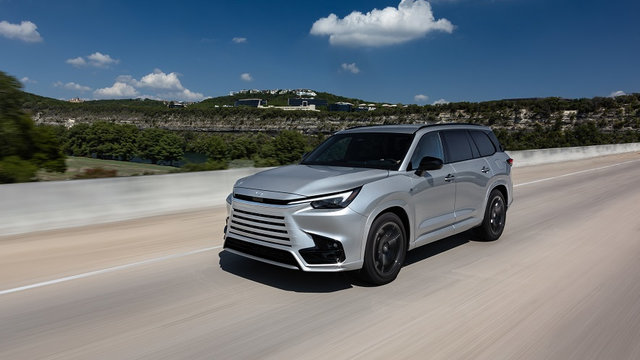
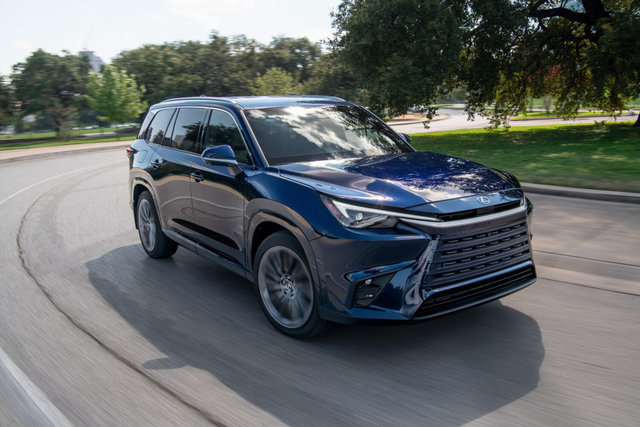
A three-row SUV lives a double life. One day it’s a highway run to a cottage, the next it’s a school pickup loop through stop-and-go traffic. For Ontario shoppers cross-shopping the TX lineup, the question isn’t just how efficient a vehicle is on paper. It’s how it behaves in the mixed, unpredictable driving that fills most weeks.
That’s where the 2026 Lexus TX 500h earns a closer look.
What The TX 500h Is Within The TX Lineup
The TX 500h is the hybrid variant of the three-row TX, sitting alongside the gas-only TX 350. Both share the same 2.4-litre turbocharged four-cylinder engine and the same GA-K platform, but the 500h pairs that engine with Lexus Hybrid Drive.
The result is a system rated at 366 horsepower and 409 lb-ft of torque, compared with 275 horsepower and 317 lb-ft on the TX 350. The hybrid system routes power through DIRECT4 all-wheel drive, standard on the TX 500h, which manages torque distribution between the front and rear axles for traction and control.
How The Hybrid System Behaves In Everyday Driving
The TX 500h’s 2.4-litre turbo engine works with the hybrid drive system through a 6-speed automatic transmission with sequential shift mode. The TX 350, by comparison, uses an 8-speed automatic. Neither transmission is the whole story; the hybrid’s electric assist changes how the engine responds at low speeds.
In stop-and-go traffic, the hybrid system can lean on electric power to move the vehicle without the turbo engine working as hard. On longer, steadier highway stretches, the gas engine carries more of the load. That shift in behaviour, rather than a single flat number, is what shapes the combined fuel economy rating.
The TX 500h posts a combined rating of 8.6 L/100 km (8.7 city, 8.4 highway). The TX 350 posts a combined rating of 10.3 L/100 km (11.5 city, 8.9 highway). The gap is widest in city driving, which is exactly where a hybrid’s electric assist does the most work.
|
Spec
|
TX 350
|
TX 500h
|
|
Engine
|
2.4 L turbo I4
|
2.4 L turbo I4 hybrid
|
|
Horsepower
|
275 hp
|
366 hp
|
|
Torque
|
317 lb-ft
|
409 lb-ft
|
|
Transmission
|
8-speed automatic
|
6-speed automatic
|
|
Combined fuel economy
|
10.3 L/100 km
|
8.6 L/100 km
|
Why Combined Driving Is The Number That Matters
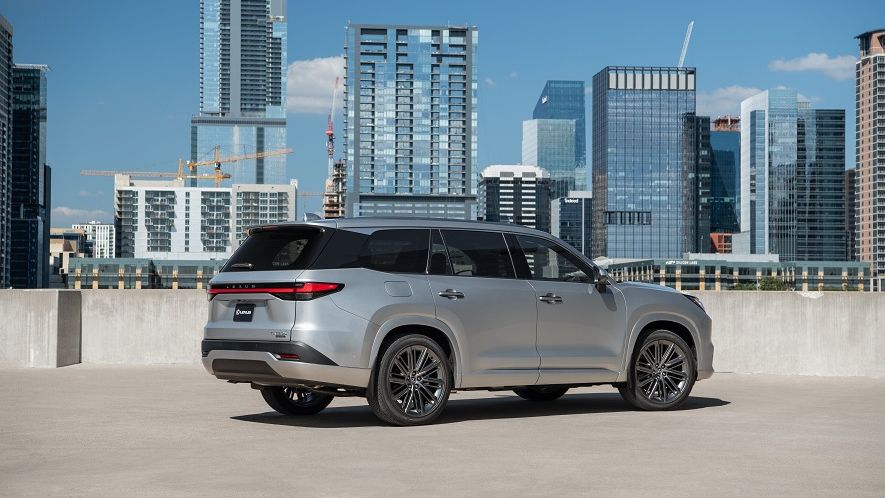
A highway-only fuel figure tells you almost nothing about how a three-row SUV actually gets used. Combined driving accounts for the mix Ontario families really put a vehicle through: city commuting, highway stretches, and the stop-start pattern of school runs and errands.
Cargo load, passenger count, and driving style all move the needle on that combined number. A TX loaded with three rows of passengers and a trunk full of hockey bags won’t match the rating of an empty highway cruise, and winter driving conditions add another variable. What the TX 500h changes is the baseline: even with those real-world variables in play, its hybrid drivetrain starts from a lower combined figure than the TX 350’s.
That’s a different priority than the TX 350 buyer typically has. The 350 buyer is choosing the simpler, more conventional drivetrain. The 500h buyer is choosing to trade some of that simplicity for a lower fuel bill across mixed use, without giving up the extra output that comes from pairing the engine with electric assist.
Who Notices The Difference Most
The efficiency gap between the TX 350 and TX 500h is most noticeable to three groups: commuters who spend real time in stop-and-go traffic, families hauling passengers and cargo on a regular basis, and anyone who wants three-row space without a highway-only mindset toward fuel use.
A highway-only driver may see less separation between the two powertrains, since the hybrid’s biggest advantage shows up in city conditions. But for drivers whose week includes both a commute and a road trip, the TX 500h’s mixed-driving strength lines up with how the vehicle will actually be used.
The three-row layout itself doesn’t change between powertrains. Both TX models offer seating for up to seven, and cargo space that runs from 57.4 cubic feet behind the third row to 97 cubic feet with the rear seats down. What changes is how efficiently that space gets moved around.
All TX 500h models come standard with Lexus Interface, Lexus Safety System+ 3, blind spot monitor, and rear cross traffic alert, so the hybrid choice doesn’t ask buyers to give up standard driver-assist technology to get better combined efficiency.
Exploring The TX 500h At Erin Park Lexus
The TX 500h pairs a 2.4-litre turbo hybrid powertrain with DIRECT4 all-wheel drive to bring combined fuel economy of 8.6 L/100 km to a three-row SUV built for family use, commuting, and longer trips alike. Its trade-offs are worth weighing against the TX 350’s simpler setup before deciding which fits your driving pattern.
Visit Erin Park Lexus in Mississauga to review TX 500h trims and feature differences with the team, and ask about scheduling a test drive to experience the hybrid system in mixed Ontario driving conditions.